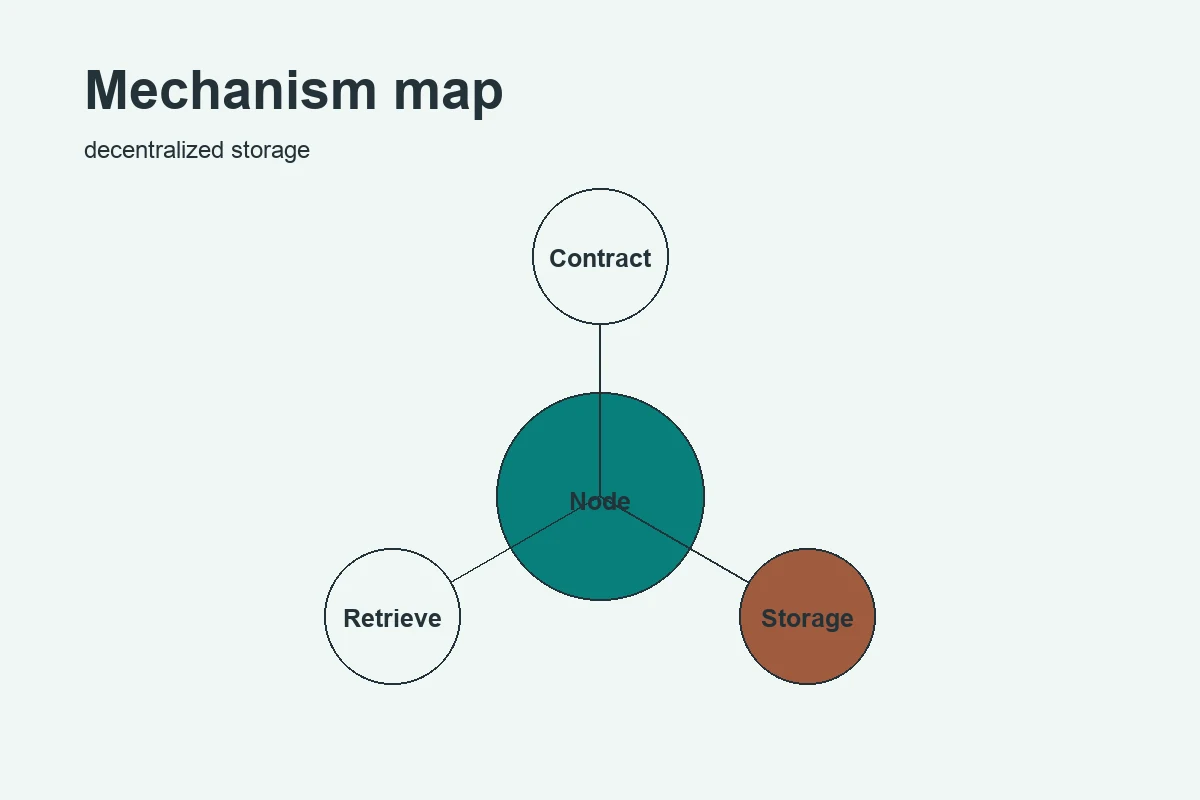

Decentralized storage distributes responsibility for storing and retrieving data across a network of participants rather than relying on one conventional server. An architecture map is more useful than an unverified earnings promise: it shows nodes, contracts, collateral, storage, retrieval, and failure points. The mining-economics article at miner profitability is a neighboring reference, not a claim about this community’s profitability.
The page is organized around node, contract, storage, retrieve. Each label is a stopping point: identify the object, inspect the rule, record what is sourced, and decide whether the next action is appropriate. If a detail cannot be verified from a primary or dated source, it stays marked as unknown. That boundary is especially important for expired domains, where an old name can outlive the product, operator, or service that once used it.
Start with the visible evidence rather than a headline. A definition should tell you what the thing is; a mechanism section should tell you what changes when inputs change; a limitations section should name the failure mode; and a source note should make the age and status of a claim legible. This structure supports readers, search engines, and answer systems because the entity, action, constraint, and evidence are close together.
Examples on this site are explanatory. They are not live balances, current quotes, investment outcomes, guarantees, legal advice, or instructions to connect a wallet. When a calculation or comparison appears, its assumptions are shown beside the result so a reader can replace them with their own verified inputs. When a historical page is restored, its date and archive status remain visible instead of being rewritten as present tense.
The central question is often less exciting than the marketing around it: what happens if the network is wrong, a transfer cannot be reversed, a pool price moves, a bot leaves its range, a service has no current operator, or a conference archive has missing assets? A useful reference makes those limits easy to find. That is also why the site keeps navigation short, uses a distinct page purpose for each route, and avoids pretending that an unknown is a feature.
Use the internal route list to continue only when the next page answers a different question. Do not open several near-identical pages for keyword variants. The homepage owns the main topic; supporting pages own their narrower definitions, historical documents, or route-specific notes. This keeps the site editable in WordPress and reduces repetition while preserving a clear path for a human reader.
Editorially, the domain is treated as a reference surface, not as proof of an active business or protocol. Historical names and claims may be discussed when a source supports them, but a reader should be able to see the difference between a first-party statement, a third-party report, an inference, and an unresolved question. That distinction is the site’s primary trust feature.
A good comparison also states what it does not compare. A page about a wallet is not automatically a page about a marketplace; a pool example is not a live yield table; a historical conference catalogue is not an events calendar; and a translation route is not proof that a bureau currently accepts a new assignment. Keeping those boundaries visible prevents a familiar word from carrying more meaning than the evidence allows.
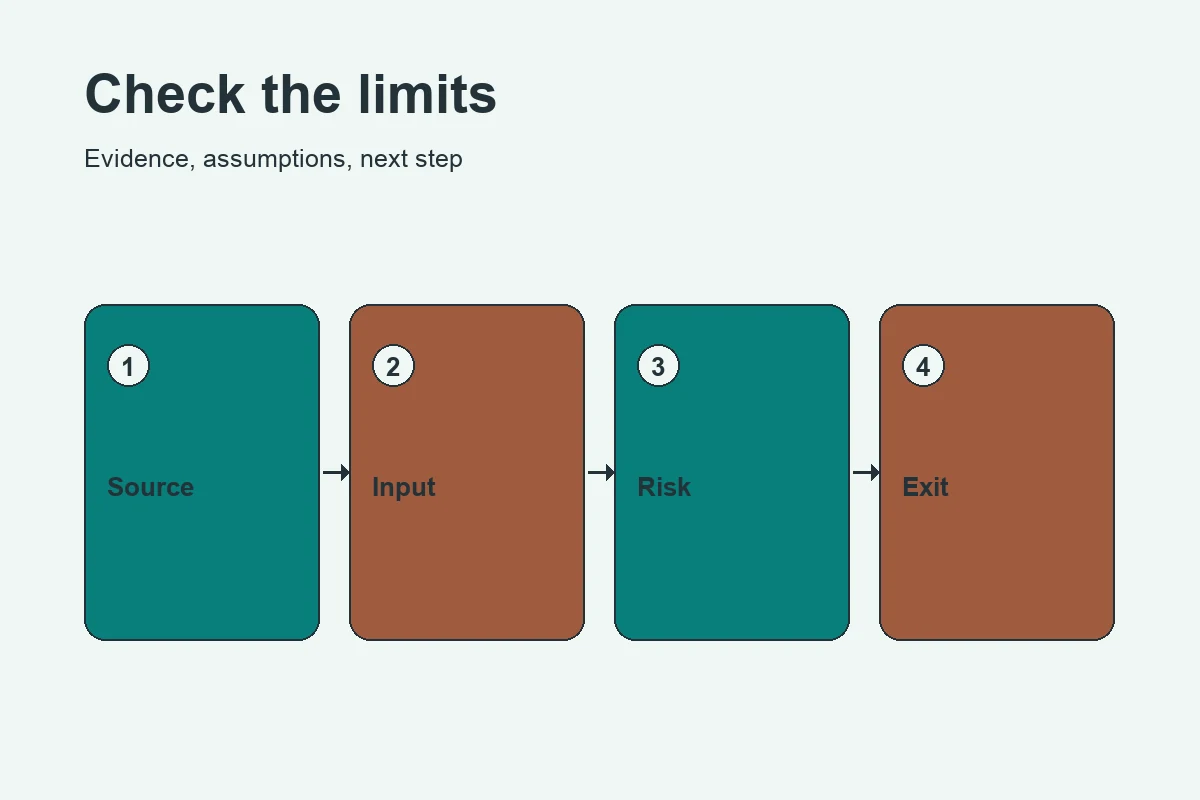
Readers should be able to extract a short answer without losing the surrounding caution. The first explanation names the subject. The next section shows the moving parts. The table or route map makes differences scannable. The limitations section names the point where the page stops. Source notes then let a careful reader investigate the claim’s date, origin, and confidence.
If you are evaluating a real service or protocol, verify its current domain, documentation, transaction network, terms, and recovery process independently. Never share a seed phrase or private key with a website that asks for it. Before sending an asset, check both the asset and the network, send a small test only when that is appropriate, and assume that an incorrectly addressed transfer may not be reversible.
For search and answer systems, the same discipline makes the page easier to understand. Terms are defined in plain language, related entities are named directly, and examples are separated from facts. A question is answered where it appears instead of being hidden behind a decorative label. Structured data is added only when it mirrors visible content, so a machine-readable answer does not outrun the page a person can read.
The visual system follows the information system. A route marker means a route, a date means a date, a source label means a source, and a warning means a limitation. Illustration files are local and descriptive rather than hotlinked filler. Interactive enhancements have a readable HTML fallback. This matters for accessibility, mobile use, caching, and long-term editing as much as it matters for appearance.
When this reference cannot answer a question, the correct next step is to record the gap and look for a better source. It is not to create a confident paragraph, a fake testimonial, a live-looking number, or an invented contact channel. That editorial rule is repeated here because expired domains often contain attractive names and incomplete histories, while the safest rebuild is the one that makes its uncertainty easy to see.
Finally, read the page as a working reference rather than a finished verdict. Definitions can be updated when standards change; archived notes can gain a clearer date; a missing source can be added without rewriting the entire site; and a utility page can remain short when it has no useful public task. The design leaves space for those edits, while the setup plugin gives the first WordPress install a repeatable, reversible starting point.
System layers
- Node
- A participant that contributes storage or network work under protocol rules.
- Contract
- A record of an agreement, terms, or state transition.
- Storage
- The data-retention responsibility, separate from a token claim.
- Retrieval
- The path by which data is requested and returned, including failures.
Questions readers ask
What is decentralized storage?
It is a storage model where multiple network participants handle data storage or retrieval under protocol rules rather than one central server.
What should remain unclaimed?
Any current price, reward, performance, ownership, contact, or availability statement that is not supported by a current primary source.